Diet culture often demonizes desserts as nutrient-deficient, sugary delights that should rarely be consumed and should always be served with heaping spoonfuls of trepidation and guilt. This rudimentary understanding of desserts not only negatively impacts our individual relationships to the foods we eat, but it also alienates desserts from their historical, political, and sociocultural underpinnings.
Conveniently enough, I was first introduced to a recipe for pound cake during the height of my own struggles with diet culture. At the time, I wasn’t able to fully comprehend the impact that diet culture had on me and my other food-related interests. Although, I do believe that this introduction to pound cake was the beginning of lifting the veil of diet culture’s superficiality. In turn, this ushered me to ask more meaningful questions about the origins of food and the methods behind making certain dishes.
As the name implies, some of the earliest recipes for pound cake from the 18th and 19th centuries called for a simple ratio: an equal pound of butter, sugar, eggs, and flour1. The pound cake’s straightforward ingredients and ratio is, in part, what made it such a favored cake so early on in American history. However, a desserts simplicity does not negate its laborious scientific processes and the pound cake is no exception. It is a cake that requires careful attention to complex mechanical and chemical reactions well before the introduction to heat. At the same time, the scientific processes behind food are not divorced from a dish’s social and historical implications. While pound cake has been a crucial part of American gastronomy since the colonial era, it was through the exploitation of domestic slavery that pound cake cemented itself as a classic Southern American dessert2.
In modern baking, a properly leavened cake is usually achieved through the use of chemical agents, such as baking powder or baking soda. These chemical leaveners ultimately yield a lighter and softer cake. However, many traditional pound cake recipes of the 18th and early 19th centuries only called for butter, sugar, eggs, and flour. During the Antebellum Period, chemical leaveners were seldom used in baking recipes. Regardless, a cake can still be properly leavened without the help of chemical leaveners. Mechanical actions, such as the creaming method or beating egg whites, can be used to create the proper structure of a cake. The creaming method, which I use at the beginning of my recipe, is the process of beating butter and sugar together until pale and fluffy. As the sugar combines with the fat, air pockets form to leaven the cake and this creates a lighter and fluffier texture. Other recipes may call for beating egg whites until foamy and doubled in volume as another way to adequately leaven a cake.
The mechanical incorporation of air into a cake batter only reiterates the importance of slave labor in shaping American gastronomical history. Coupled with having to forcibly maintain the day-to-day chores of a slave-owning household, domestic slaves also took on the monotonous and laborious tasks of properly stirring, beating, mixing, and baking a cake. In a period that predates chemical leaveners, hand mixers, and stand mixers, the making of a pound cake was all the more time consuming and labor intensive. These tasks had to be done by hand. For domestic slaves, the proper execution of these mechanical leavening processes also meant life or death.
The pound cake’s simple ingredients and easy ratio were only part of the equation to its rise in popularity. These labor intensive cakes could not have cemented themselves as a staple of Southern American culinary history without the exploitation of slave labor. The violent imposition of domestic labor onto slaves was the final ingredient that was needed in order to transform an equal pound of butter, sugar, eggs, and flour into a proper pound cake.
As with all past and present dessert recipes, this pound cake recipe is a culmination of historical and social circumstances that are unfortunately wrought with systematic oppression and violent human interaction. Today, we are faced with a society that upholds and praises diet culture, which enshrines a mentality where we continuously perceive food as our enemy and fatness as the ultimate corporal punishment. This cyclical relationship only serves to deepen the abnormal social expectations we have concerning our bodies, the fears surrounding being treated as a fat person, and the moral hierarchies associated with “good” and “bad” foods. We are, at one extreme, hyper-fixated with the numbers on a scale and, on the other extreme, completely apathetic to the racialized exploitation and fatphobia embedded within our society. All the while, it is both racialized exploitation and fatphobia that simultaneously drive our collective obsession with thinness and our collective dissonance towards race and class in culinary history.
If you ever do find yourself making this recipe, I hope you are able to enjoy a slice of cake without the essence of guilt lingering in the back of your tongue. More importantly, I hope both you and I are able to remove the layers of demonization surrounding our bodies and the food we consume to better understand our bodies, the origins of food, and food culture as a racialized politic and a history of class struggle.
- Patent, Greg. “Please Don’t Call It Pound Cake.” Gastronomica: The Journal of Food and Culture 9, no. 3, 59-62.
- Overby, Rachel. “A Cakewalk Through History: The Evolution of Cake and its Identity in America.” Undergraduate thesis. Butler University, 2018.
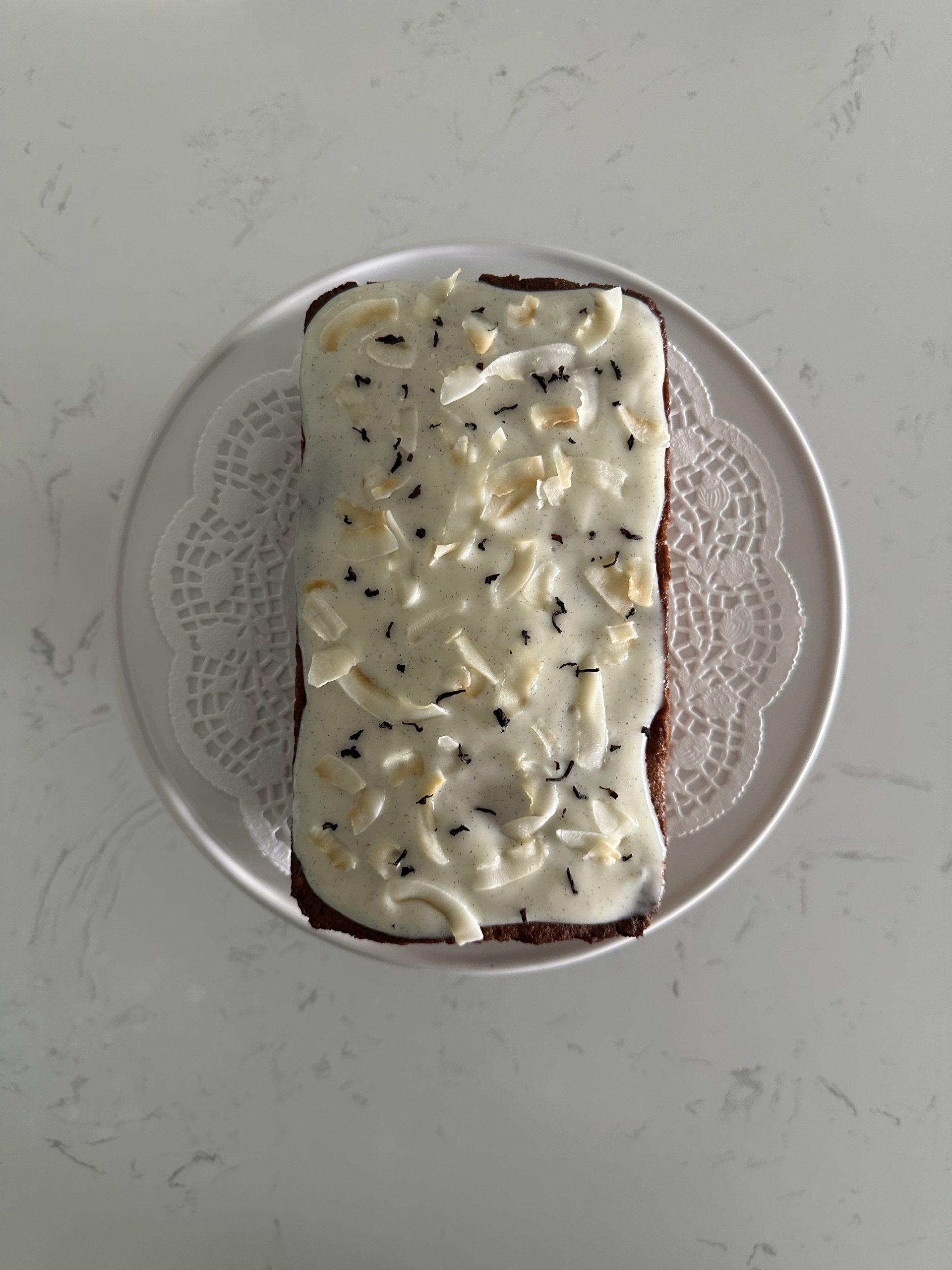
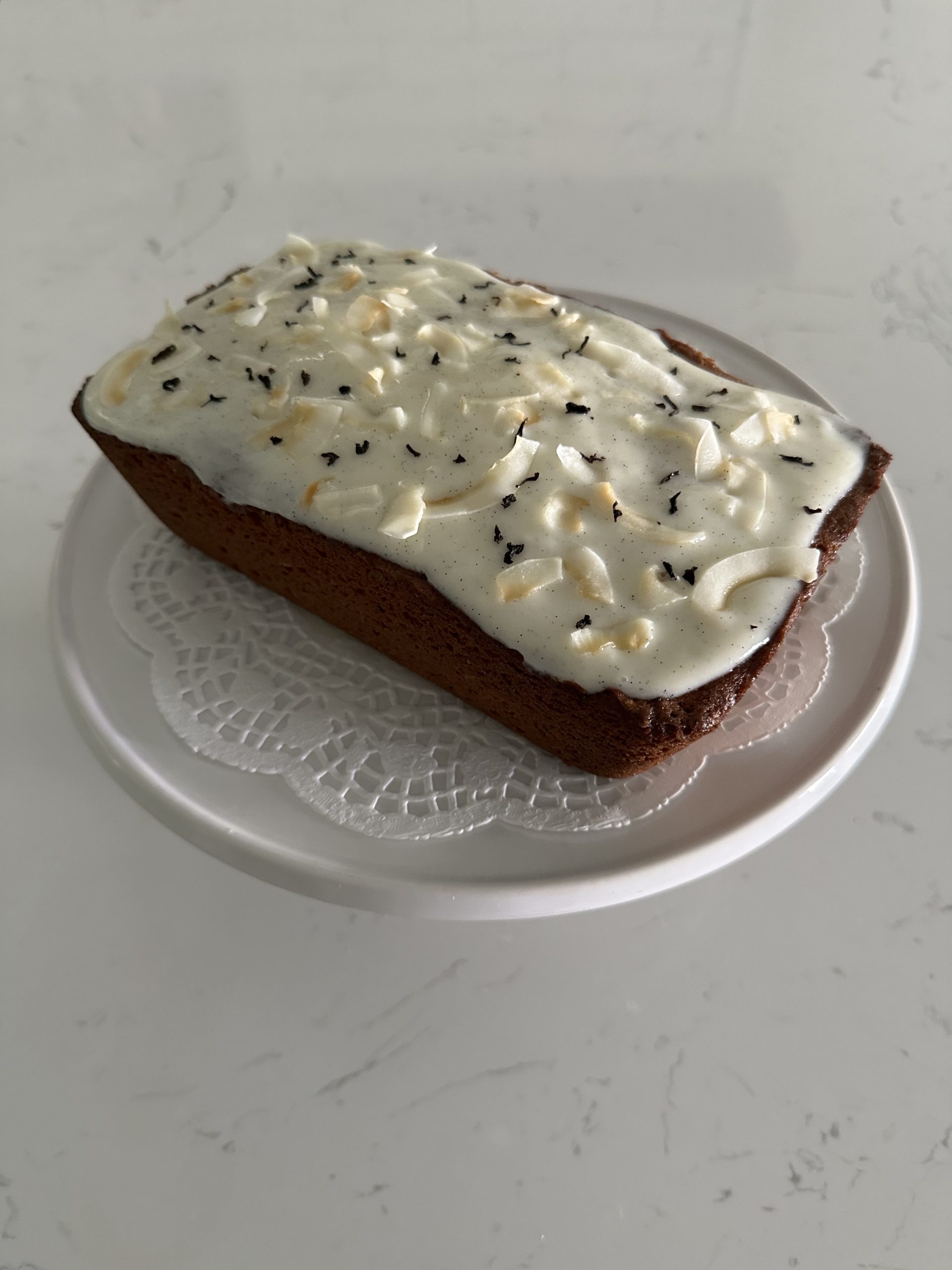

Earl Gray Coconut Pound Cake
Ingredients
For the pound cake:
- 1 ½ cups AP flour spooned and leveled
- 1 tsp baking powder
- ¼ tsp baking soda
- ½ tsp kosher salt
- ½ tsp ground cinnamon
- 1 tbsp Earl Gray tea see note
- ½ cup sweetened coconut shreds
- 1 cup unsalted butter room temperature
- ¾ cup granulated sugar
- 2 large eggs room temperature
- ⅔ cup sour cream room temperature
- 1 tbsp vanilla paste or vanilla extract
- 1 tsp coconut extract
For the sour cream glaze:
- ¼ cup unsweetened coconut flakes
- ⅓ cup powdered sugar
- ¼ cup sour cream
- 1 tbsp milk dairy or plant-based
- 1 tbsp vanilla paste or vanilla extract
Instructions
For the pound cake:
- Preheat the oven to 325°F. Grease a 9 x 5” loaf pan with butter and set aside.
- In a large bowl, sift together the flour, baking powder and soda, salt, and cinnamon. Add the tea and the shredded coconut. Stir until the shreds are evenly distributed throughout the flour. Set aside.
- In a stand mixer with the paddle attachment, or hand mixer, beat the butter and sugar together until pale in color and fluffy, about 6-8 minutes. Be sure to scrape the paddle and sides every once in a while.
- Add the eggs one at a time. Ensure that each egg is thoroughly mixed into the batter before adding the next one.
- After the eggs are well incorporated, add the sour cream, vanilla paste, and coconut extract. Stir until the ingredients are just combined.
- Add the wet ingredients into the dry, and with a rubber spatula, gently fold the ingredients until there are no visible streaks of flour left. Do not overmix!
- Evenly pour the mixture into the prepared loaf pan and bake for 1 hour and 5 minutes, or until the middle is set and a toothpick inserted in the middle comes out clean.
- Allow the cake to cool for 10 minutes inside the pan before inverting it onto a cooling rack and allow it to cool for 15 more minutes.
For the sour cream glaze:
- Add the coconut flakes into a large, dry skillet. Over medium-low heat, toast the coconut flakes while constantly stirring. When the coconut flakes are an even golden brown color, remove from the heat and allow them to cool completely.
- In a bowl, whisk together the powdered sugar, sour cream, milk, and vanilla paste until everything is well combined.
- Add the frosting to the cake and top with the toasted coconut flakes and a sprinkle of earl gray tea leaves.
Notes
Enjoy! <3


Leave a Reply